# Github-Recon 🔍


- [🧾 Project Overview](#-project-overview)
- [🚀 Features](#-features)
- [⚠️ Disclaimer](#%EF%B8%8F-disclaimer)
- [📦 Installation](#-installation)
- [With Go](#with-go)
- [With Nix/NixOS](#with-nixnixos)
- [🧪 Usage](#-usage)
- [Flags](#flags)
- [Token](#token)
- [How does the email spoofing work?](#how-does-the-email-spoofing-work)
- [💡 Examples](#-examples)
- [🕵️♂️ Cover your tracks](#%EF%B8%8F%EF%B8%8F-cover-your-tracks)
- [🤝 Contributing](#-contributing)
- [🙏 Credits](#-credits)
## 🧾 Project Overview
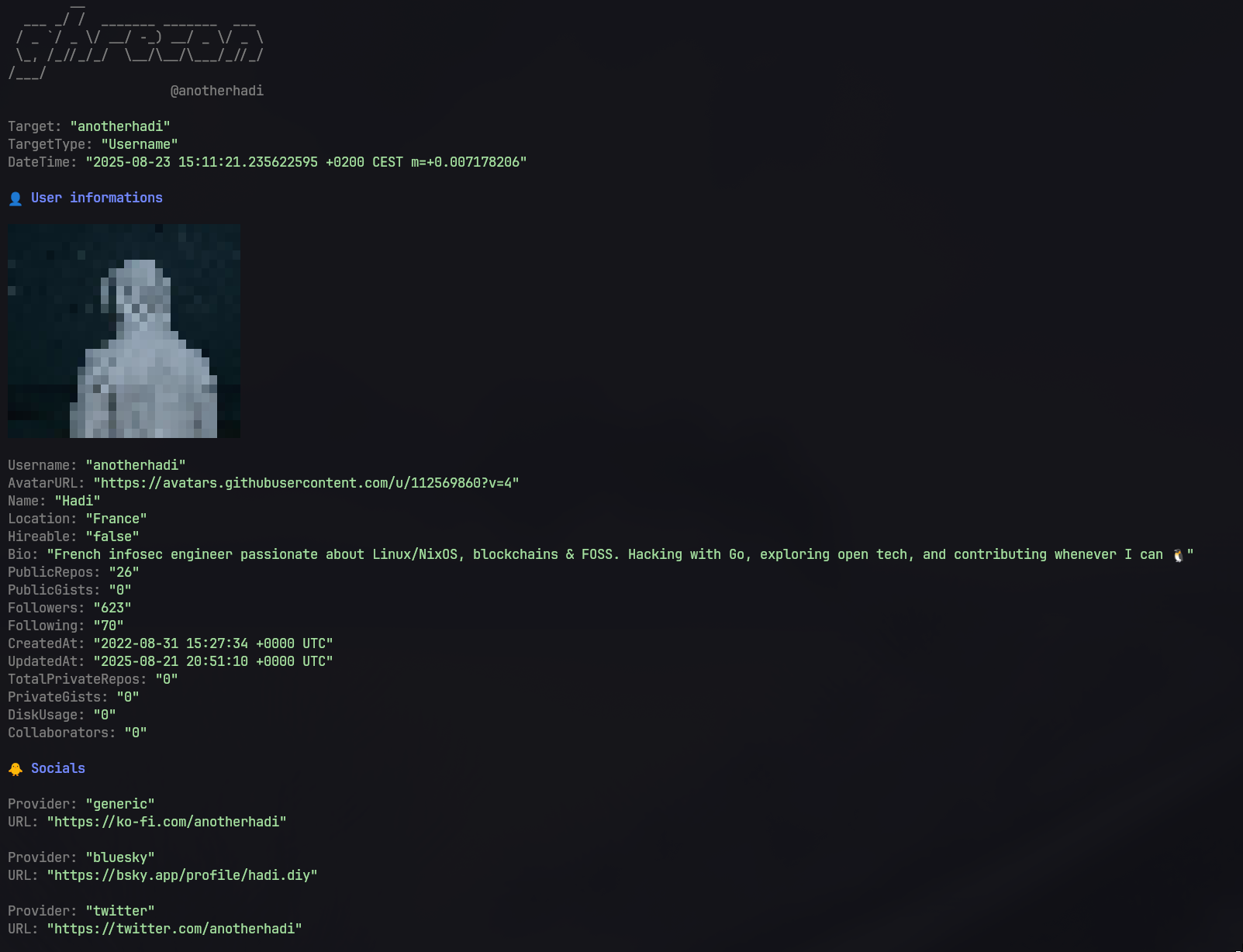
Retrieves and aggregates public OSINT data about a GitHub user using Go and the
GitHub API. Finds hidden emails in commit history, previous usernames, friends,
other GitHub accounts, and more.
Screenshot
## 🚀 Features
- Export results to JSON
**From usernames:**
- Retrieve basic user profile information (username, ID, avatar, bio, creation
date)
- Display avatars directly in the terminal
- List organizations and roles
- Fetch SSH and GPG keys
- Enumerate social accounts
- Extract unique commit authors (name + email)
- Find close friends
- Deep scan option (clone repositories, run regex searches, analyze licenses,
etc.)
- Use Levenshtein distance for matching usernames and emails
- TruffleHog integration to find secrets
**From emails:**
- Search for a specific email across all GitHub commits
- Spoof an email to discover the associated user account
## ⚠️ Disclaimer
This tool is intended for educational purposes only. Use responsibly and ensure
you have permission to access the data you are querying.
## 📦 Installation
### With Go
```bash
go install github.com/anotherhadi/github-recon@latest
```
### With Nix/NixOS
Click to expand
**From anywhere (using the repo URL):**
```bash
nix run github:anotherhadi/github-recon -- [--flags value] target_username_or_email
```
**Permanent Installation:**
```bash
# add the flake to your flake.nix
{
inputs = {
github-recon.url = "github:anotherhadi/github-recon";
};
}
# then add it to your packages
environment.systemPackages = with pkgs; [ # or home.packages
github-recon
];
```
## 🧪 Usage
```bash
github-recon [--flags value] target_username_or_email
```
### Flags
```txt
-t, --token string Github personal access token (e.g. ghp_aaa...). Can also be set via GITHUB_RECON_TOKEN environment variable. You also need to set the token in $HOME/.config/github-recon/env file if you want to use this tool without passing the token every time. (default "null")
-d, --deepscan Enable deep scan (clone repos, regex search, analyse licenses, etc.)
--max-size int Limit the size of repositories to scan (in MB) (only for deep scan) (default 150)
-e, --exclude-repo strings Exclude repos from deep scan (comma-separated list, only for deep scan)
-r, --refresh Refresh the cache (only for deep scan)
-s, --show-source Show where the information (authors, emails, etc) were found (only for deep scan)
-m, --max-distance int Maximum Levenshtein distance for matching usernames & emails (only for deep scan) (default 20)
--trufflehog Run trufflehog on cloned repositories (only for deep scan) (default true)
-S, --silent Suppress all non-essential output
--spoof-email Spoof email (only for email mode) (default true)
-a, --hide-avatar Hide the avatar in the output
-j, --json string Write results to specified JSON file
```
### Token
For the best experience, provide a **GitHub Personal Access Token**. Without a
token, you will quickly hit the **rate limit** and have to wait.
- For **basic usage**, you can create a token **without any permissions**.
- For the **email spoofing feature**, you need to add the **`repo`** and
**`delete_repo`** permissions.
You can set the token in multiple ways:
- **Command-line flag**:
```bash
github-recon -t "ghp_xxx..."
```
- **Environment variable**:
```bash
export GITHUB_RECON_TOKEN=ghp_xxx...
```
- **Config file**: Create the file `~/.config/github-recon/env` and add:
```env
GITHUB_RECON_TOKEN=ghp_xxx...
```
> [!WARNING]
> For safety, it is recommended to create the Personal Access Token on a
> **separate GitHub account** rather than your main account. This way, if
> anything goes wrong, your primary account remains safe.
### How does the email spoofing work?
Here’s the process:
1. Create a new repository.
2. Make a commit using the **target's email** as the author.
3. Push the commit to GitHub.
4. Observe which GitHub account the commit is linked to. This method **always
works**, but it only reveals the account if the email is set as the user’s
**primary email**.
All of these steps are handled **automatically by the tool**, so you just need
to provide the target email.
## 💡 Examples
```bash
github-recon anotherhadi --token ghp_ABC123...
github-recon myemail@gmail.com # Find github accounts by email
github-recon anotherhadi --json output.json --deepscan # Clone the repo and search for leaked email
```
## 🕵️♂️ Cover your tracks
Understanding what information about you is publicly visible is the first step
to managing your online presence. github-recon can help you identify your own
publicly available data on GitHub. Here’s how you can take steps to protect your
privacy and security:
- **Review your public profile**: Regularly check your GitHub profile and
repositories to ensure that you are not unintentionally exposing sensitive
information.
- **Manage email exposure**: Use GitHub's settings to control which email
addresses are visible on your profile and in commit history. You can also use
a no-reply email address for commits. Delete/modify any sensitive information
in your commit history.
- **Be Mindful of Repository Content**: Avoid including sensitive information in
your repositories, such as API keys, passwords, emails or personal data. Use
`.gitignore` to exclude files that contain sensitive information.
You can also use a tool like [TruffleHog](github.com/trufflesecurity/trufflehog)
to scan your repositories specifically for exposed secrets and tokens.
**Useful links:**
- [Blocking command line pushes that expose your personal email address](https://docs.github.com/en/account-and-profile/setting-up-and-managing-your-personal-account-on-github/managing-email-preferences/blocking-command-line-pushes-that-expose-your-personal-email-address)
- [No-reply email address](https://docs.github.com/en/account-and-profile/setting-up-and-managing-your-personal-account-on-github/managing-email-preferences/setting-your-commit-email-address)
## 🤝 Contributing
Feel free to contribute! See [CONTRIBUTING.md](CONTRIBUTING.md) for details.
## 🙏 Credits
Some features and ideas in this project were inspired by the following tools:
- [gitrecon](https://github.com/GONZOsint/gitrecon) by GONZOsint
- [gitfive](https://github.com/mxrch/gitfive) by mxrch
Big thanks to their authors for sharing their work with the community.